

From Disconnected Tools to a Scalable, System-Driven eCommerce Operation
Industry : eCommerce / Consumer Products
Business Model : Direct-to-consumer via Shopify
Challenge : Siloed systems, manual ops
Outcome : Centralized ERP + 2× sales growth

The Challenge
A fast-growing eCommerce business had built its operations around four disconnected platforms: Shopify for online sales, Fishbowl for inventory and manufacturing, ShipStation for shipping, and QuickBooks for accounting. On paper, each system did its job. In practice, they barely spoke to one another.
The result was a fragile operational foundation held together by manual effort. Every order change, inventory adjustment, or financial reconciliation required someone to touch multiple systems. Inventory counts were unreliable, and that unreliability had a real cost: overselling. Kits and bundled products created fulfillment headaches that the existing integrations simply couldn’t handle.
Most critically, the business had hit a ceiling. Demand was growing, but operations couldn’t keep pace. The systems that worked at an earlier scale had become a brake on growth.
Root Causes Identified
- No single source of truth for inventory, orders, or financials
- Manual reconciliation created a lag between operations and accounting
- Kit/bundle logic unsupported by existing integrations
- Order changes require human intervention across multiple platforms
- Overselling caused by inventory inaccuracies across locations
- Unclear system ownership created duplication, conflict, and exception-handling gaps

“The business could not scale operations at the same pace as demand — not because of a lack of customers, but because of a lack of operational infrastructure.”
The Solution: Odoo as the Operational Core
Novobi redesigned the client’s operating model around a clear principle: system ownership had to be defined before automation could scale. Odoo became the system of record for orders, inventory, manufacturing, and accounting.
Rather than building point-to-point integrations between every tool, Novobi implemented a hub-and-spoke model. Each platform was assigned a clear, non-overlapping role:
Shopify
the customer-facing storefront and source of orders and payout data
Odoo
the central orchestration engine for orders, inventory, manufacturing, and accounting
ShipStation
the execution layer for shipping and carrier management
This architecture eliminated the ambiguity that had plagued the previous setup. With Odoo as the system of record, every downstream action from fulfillment routing to financial posting flowed from a single, authoritative data source.
Integration Architecture
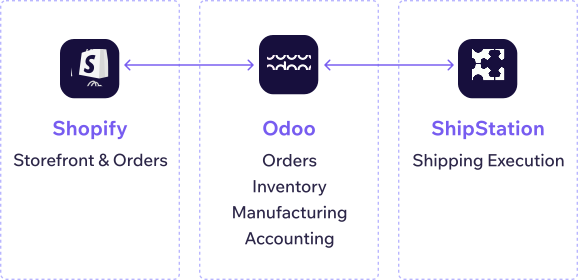
Key Capabilities Implemented
- Real-time order sync from Shopify into Odoo with full lifecycle management
- Payout reconciliation: Shopify payouts mapped directly to Odoo accounting
- Bill of Materials (BoM) and kitting logic for complex bundle fulfillment
- Multi-location inventory tracking across warehouses and 3PL partners
- Automated financial postings tied to every operational transaction
- Bidirectional shipping integration: Odoo triggers ShipStation; tracking flows back
Before & After
Before
- Shopify, Fishbowl, ShipStation & QuickBooks in silos
- Manual order changes and inventory adjustments
- Financial reconciliation done by hand
- Inventory inaccuracies led to overselling
- Shipping workarounds for kits and bundles
- No unified operational visibility
After
- Odoo as the central orchestration engine
- Orders flow automatically: Shopify → Odoo
- Payouts sync from Shopify → Odoo, Bank → Odoo
- Real-time inventory accuracy across multiple Shopify instances
- Proper kit explosion and pick/pack logic
- End-to-end visibility from order to financials
The Novobi Process


Results & Business Impact
The transformation delivered measurable results from the moment the new system went live. With Odoo as the operational backbone, the business was no longer constrained by the limitations of its tooling — it could finally grow at the pace its demand demanded.
2x
Increase in Total Sales
100%
Order & Inventory Automation
0
Overselling Incidents Post-Launch
What Changed Operationally
- Order and inventory sync fully automated, no manual intervention required
- Financial reconciliation connected end-to-end between Odoo, Shopify, and the bank
- Overselling eliminated through real-time, multi-location inventory accuracy
- Pick, pack, and ship cycles accelerated with proper kit explosion logic
- Operational visibility from order creation through delivery and invoicing
- Accounting transactions tied directly to operational events: no lag, no guesswork
With the operational ceiling removed, the business doubled total sales — not by adding headcount, but by building a system that could scale with demand.

Why Odoo + Novobi
Odoo’s strength in this engagement wasn’t any single feature; it was the unified architecture. Sales, inventory, manufacturing, and accounting aren’t bolted together in Odoo; they’re built as a unified system.
Novobi’s role was to design and execute the transformation to align with the client’s operational reality. That meant building the right logic for kitting, mapping Shopify payouts to Odoo’s accounting model, and ensuring that every automated workflow accounted for the edge cases that break most implementations.
The result is an eCommerce operation that is no longer reactive. It’s system-driven, scalable, and built to grow.